
Tourism: the locomotive’s zigzags
While the leisure industry in 2013 is threatening with not meeting the plans and results of the previous year, and the crisis is hitting several issuing markets, the Cuban government is boosting investments and adopting measures to promote a sector set to maintain with its demand other activities of the national economy.
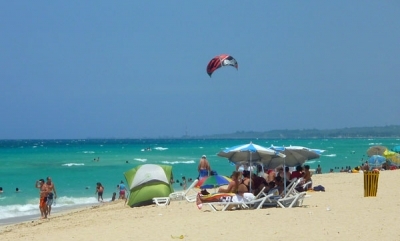
The Cuban tourism industry is running the risk of living in 2013 greater frustrations than those of a year before. Judging by the close of the third quarter, the influx of foreign visitors could be below the figure rounded off in 2012.
The summer saw reanimation efforts but this did not lessen the doubts. As compensation, the strong investment plans begun by the government, in a sector that it considered strategic in more than one sense, could turn around perhaps in the short term the current stagnation in the reception of tourists.
Last year the number of visitors grew 4.5 percent, but did not meet the goals set by the Tourism Ministry (MINTUR). That agency had forecasted a five percent increase over the amount of 2011, to more than 2.9 million foreign tourists. But according to data from the National Office of Statistics and Information (ONEI), only 2,833,000 visitors arrived.
During a meeting of the parliament commission on attention to services, Tourism Minister Manuel Marrero recognised the non-fulfilments and blamed them on a combination of domestic weaknesses and foreign storms.
The minister admitted marketing insufficiencies by hotel chains, travel agencies and other entities of the area, which had an influence on a lower reception of guests than previewed and on an also lower increase of income than planned. According to the ONEI, the dividends contributed by tourism went up in 2012 in a magnitude close to the growth in visitors: 4.4 percent, for up to 2.613 billion convertible pesos (CUC, equivalent to the U.S. dollar, according to the official exchange rate).
Among the conflicts, Marrero also alluded to the suspension of tourist cruises from Europe, the decrease in arrival of émigrés from the United States and the impact of the economic crisis in European countries, like Spain and Italy.
But he also pointed to the presence of subjective difficulties at home. “We have to make an effort every day for them to be fewer and that they not be the same,” he said before the MPs. He added that there were reserves of efficiency and “problems whose solution is within reach of the different enterprises and institutions.” He gave as example the possibility of “reducing expenditures to increase the income attracted through the sale of tourist and optional packages.”
Cuban tourism’s horizons, however, continue being gloomy this year because of problems with similar roots.
In the aforementioned parliamentary meeting, Marrero announced plans for surpassing in 2013 the arrival of 3.1 million tourists, but reality is threatening MINTUR’s forecasts with a nasty surprise. Once again, the three million figure could be an evasive dream.
The minister assured that the 2013 plans were not taking as a reference the results of previous years, but rather the real potentials of the markets and the available capacities in the country. “That plan is based on resolving the problems we had in 2012,” he said to the MPs. “We also have to continue strengthening the quality of services, the most important element to differentiate our tourist product.”
But the data registered during the current year not only questions those estimates and expectations, but also puts at risk the possibility of achieving at least a similar amount of visitors as that of 2012.
Crisis hits European issuing markets
At the close of the tenth month of 2013, the reception of international visitors decreased 1.2 percent as compared to the same period the previous year: 2,312,609 foreigners arrived according to the most recent ONEI report. The tourist entities’ direct revenues reported by the same source remained the same in the first semester at levels equivalent to the first six months of 2012, a stagnation that reveals little reaction from the hotel industry, tour operators and related installations to gain in efficiency when the time comes for billing, or the tourists’ reluctance to use their credit cards or spend money.
The arrival of tourists tried to recover the pace in August, with a total of 4.4 percent that month, but later again retook the downward trend that has predominated during the year. In 2013 only one month closed with an increase: March (+1.3%).
Among the issuing markets, Spain and Italy, with respective decreases of 13.4 percent and 10.9 percent up to the close of the third quarter, are prolonging this year the collapse they have been dragging since 2007, increasingly more accentuated. While in 2005 both countries ranked third and fourth, each one, among the foreigners who most visited Cuba, at the close of last September Italy had gone down to fifth place and Spain to eighth. In 2012 the Italians ranked fourth, while the Spaniards had already gone down to eighth place.
The European financial crisis – more acute in these two countries, and in Greece and Portugal – raises the unemployment quota and reduces the potential issuing of tourists. When travellers from that nationality dare to cross the Atlantic to visit Cuban beaches or other Caribbean destinations, their disposition to spend is limited by the economic uncertainty they leave behind.
It’s not by chance that among the sources of income of the Cuban tourist entities, the indicators of recreation and retail commerce have suffered the most, with respective decreases of four percent and 1.9 percent in the first six months of this year as compared to the same period in 2012. Transport and gastronomy were obviously better off, though with not much growth (1.2% and 1.1% each one), while the income for accommodations practically did not vary, according to the ONEI report.
However, these are not the only issuing markets showing signs of alarm. Canada, the usually principal market with more than a third of the visitors arriving in Cuba, barely grew 1.6 percent from January to September 2013 as compared to the same period in 2012; that year the number of Canadians who travelled to the largest of the Antilles registered a 6.9 percent growth and repeated the figure of more than a million (1,071,696), 37.8 percent of the total.
British visitors, who traditionally held second place, decreased 0.9 percent at the close of September, after having declined 12.6 percent in 2012 as compared to the previous year.
Meanwhile, some emerging markets that had registered a better performance in the issuing of tourists to this Caribbean country have registered a strong decrease, despite which they continue being a sort of lifesaver toward which the Cuban leisure industry is reorienting its marketing policies.
In pursuit of new markets
The recent shadows have spread toward alternatives on which the Cuban authorities have set their hopes. After a 10.7 percent growth in 2012, Russian tourists have dropped 17.9 percent in the first nine months of 2013. However, judging by recent operations, the traffic of tourists from Cuba’s former political ally could potentially increase during the peak season.
The Russian tour operator Pegas Turistik inaugurated in late October a direct flight from Moscow to Cuba’s principal beach resort, Varadero. With a fortnightly frequency, that company will bring vacationers on board Boeing 777s with a 364 seating capacity of the Orenair airline. The supervisor of Pegas in the Caribbean, Irina Lavrenova, told the press that “this operation, at first, will continue until May and I believe it will be mutually advantageous because it is an important destination.”
“Cuba is very beautiful,” she said, “and Russian tourists are greatly interested in visiting it because of its beaches and the sun.”
Ranked in 2012 in 10th place among the 25 best beach destinations in the world, according to the world’s most important travel website, TripAdvisor, the Varadero destination is actively seeking alternatives to attract clients in other parts of Europe. For the first time, it has established a direct connection with the Nordic countries starting in November. The famous Cuban beach resort’s Juan Gualberto International Airport is expecting travellers from Denmark, Finland, Iceland, Norway and Sweden fleeing from the snow of the crude Scandinavian winter.
Varadero also has had air connections with new markets from Eastern Europe or has expanded them with nations that are more acquainted with its hotels. The LOT airline opened fortnightly charter flights during the five months of the peak season. The beach resort aims to also give a boost to the arrival of Germans through an air connection with Munich, which it will maintain until April next year.
Argentina, another issuing market with which Cuba’s ties have grown, partially was reanimated in the third quarter as compared to a more sombre first quarter. But the 5.5 percent decrease until the close of September is still far from the Argentineans’ 24.6 percent spectacular leap last year and that positioned them from ninth place in 2011 to sixth in 2012, among the foreigners who most visited the Cuban archipelago.
The sector’s authorities and companies have guaranteed a marketing policy to diversify their issuing markets. The strong increases from the emerging economies from Argentina, Russia, China, Brazil, Colombia, Venezuela and Peru confirm the benefits of that strategy. Together with important markets that have remained stable, like Canada and Germany, that marketing reorientation has been one of the supports of the recovery until 2012.
After successive drops in 2006 and 2007, the arrival of visitors gradually took off starting the following year, at an approximate rate of 5.7 percent a year. The upward trend started in 2008, despite the impact of the economic crisis that hit the world late that year from the global finance hub, Wall Street, and in Cuba it was added to the serious damages caused by three hurricanes between August and September 2008.
The more decisive commercial rapprochement to the emerging markets of Asia and South America, which have made up for the European lows, has had an influence in this good performance. But the partial data of the current year confirm that those new alternatives, in addition to still having a minority participation as compared to Europe, still have not become consolidated.
However, not everything depends on the financial storms that agitate countries that are fundamental for the Cuban leisure industry or its own problems, as the island’s government officials have recognised. International reports indicate that that sector is one of those that have shown the most resistance in the face of the international economic crisis, though Cuba is located in one of the regions hit the hardest, judging by the results it is exhibiting.
WTO optimistic about 2014
The World Tourism Organisation (WTO) continues placing its trust on that sector’s possibilities in the world. In tune with the results of last year, it previews favourable perspectives for 2014, especially for the so-called emerging economies on which Cuba’s leisure industry is depositing a great deal of its hopes for growth.
The most recent report known as the WTO Barometer, published last October, reveals that the arrival of international tourists in the world grew five percent in the first eight months of this year. This data exceeds the forecasts announced by that organisation, which at the start of the year expected a growth of between three and four percent, in line with its long-term prediction estimated at an annual average 3.8 percent for the period of 2010 to 2020.
Up to the close of August, a record 747 million persons travelled the world as tourists, 38 million more than the same period in 2012. A survey among WTO experts concluded that after a solid start of the year, the demand of international tourism maintained its strength during the peak season of the northern hemisphere.
The eight-month stage previews a rising close this year, especially taking into account an improvement in the European zone, where the number of visitors increased five percent up to August. But it also confirms that the emerging economies continua at the head of the reaction of that sector, from the point of view of the issuing of tourists and their spending, details that matter a great deal to the Caribbean destinations.
In 2012 the amount of persons who travelled in the world as tourists grew four percent and surpassed the figure of a billion persons for the first time in history. The WTO Barometer reported 1.035 billion tourist arrivals that year. In the same proportion, the revenues from that industry increased by four percent to reach 1.75 trillion dollars. Added to the 219 billion dollars contributed by international passenger transport, the value of tourism-related exports rose to 1.3 trillion dollars.
The Secretary General of the WTO, Taleb Rifai, considered that it was encouraging to confirm that the growth in arrivals of international tourists was equalled by a growth comparable to spending, despite the continuous economic challenges, he said when referring to the financial crisis being experienced by important centres of world economy like Western Europe.
Taking into account that tourism is a key export for many world economies, he summarised in 2012, this result is good news since it provides destinations with hard currency reserves and contributes employment in tourism as well as in related economic sectors.
More encouraged by the figures of this year, Rifai said during the inauguration of the Vilnius European Forum on Tourism, held last October, that while the world economic growth continues being slow, the results of international tourism are still above the mean in the major part of the world regions, opening vital opportunities for employment and for the local economies. He defined this process as especially important for Europe, where unemployment is a topmost concern in numerous destinations and where the tourist sector has created job posts in the last decade.
In general, the emerging economies reiterated in 2012 a greater increase in the reception of tourists than the advanced economies: 4.1 percent the first as compared to 3.6 the second, according to the WTO Barometer.
A data confirms how timely it was to reorient the Cuban marketing sights on new markets. China became number one among the issuing markets, with an impetuous growth from 10 million travellers in 2000 to 83 million in 2012.
By regions, however, Europe is still the world’s largest issuer of tourists, with more than half, followed by Asia and the Pacific (23%), the Americas (17%), Middle East and Africa (3% each one). Moreover, if the renowned WTO Barometer registers that “the majority of the tourists visited destinations located in their own region,” this places the Cuban industry in the face of the pressing need to strengthen the collaboration efforts that have been presented when confronted with the regional competition of the Caribbean and South America. The Asian experience and its results are revealing.
In 2012, the arrival of international visitors increased more in Asia and the Pacific, seven percent (a total of 233 million), results in which the strong policies of regional cooperation and coordination in matters related to tourism have had an influence. Africa ranked second in growth rate, with a six percent hike in 2012 (52 million), after the bad spell of 2011.
In the Americas, the reception of tourists grew four percent (162 million), including the Caribbean, which with an advance of similar proportion improved the results of the two previous years.
Europe showed a moderate growth of three percent, but continues being the most visited part of the world (535 million) and the hot spot of the Middle East was the only region with losses (-5%).
To the abovementioned is added that the highest spending growth rates abroad, according to the WTO, are found in the emerging economies. The Chinese, with a total of 42 percent as compared to 2011, last year climbed to the head of the most lavish. In terms of international tourism, travellers from that enormous nation have multiplied eightfold the money used on purchases and other tourism-related activities. Russia, with another impressive advance of 31 percent in 2012, climbed from seventh to fifth place in the spending ranking, preceded by three classics: Germany, the United States and United Kingdom, in second to fourth place in that order.
Meanwhile, Brazil jumped from position 29 to the 12th. Other smaller markets, but with significant growths in that indicator are Norway, United Arab Emirates, Switzerland, Malaysia, Kuwait, Poland, the Philippines, Thailand, Qatar, Ukraine, Egypt and Colombia.
Europe is showing understandable ambivalences. German and British tourists, in tune with the more stable economic situation in their countries, spent abroad six and four percent more, respectively. In comparison, personal investment decreased six percent in the case of the French and one percent among the Italians.
The increase of Chinese or Russian tourists visiting Havana, Trinidad and Santiago de Cuba or other historic cities, or taking in the sun on the sands of a Cuban beach is evidently not by chance. While the Russian Federation has climbed in 10 years from position 17 to seventh place in 2012 among the principal issuing markets for the Cuba destination, China appears now in 16th place, though in 2002 its visitors were not seen in the registries of the Statistical Yearbook or in the streets of Cuba.
But the hotel networks established in tourist destinations in this Caribbean country have also found guests and relief in a much closer place.
Open doors for local tourists
The opening of hotel rooms for local tourists came as a godsend for the smokeless industry. With a faster than previewed evolution, it partially compensates for the lukewarm arrivals from foreign markets this year.
Five years ago, nationals could only gain access to hotel services, like the restaurants, due to the prohibition applied by the government in the 1990s, under the criterion of taking advantage of the few hotel resources when it re-launched international tourism as an alternative in the face of the economic crisis of those years.
However, after the change, the amount of Cubans who have stayed in their country’s hotels has registered a vigorous growth. It increased 12.6 percent in the first seven months of this year as compared to the same period in 2012, for a total of 339,470, according to data from the Tourism Ministry (MINTUR) published by the magazine Bohemia.
Just in July and August, the two summer months preferred by Cubans for their vacations, some 200,000 nationals made reservations in hotel installations, while the record number of Cubans staying in hotels in just one day was broken on August 17 (17,099). The sector expects to close the year with around 625,000 national hotel guests, almost 100,000 more than in 2012.
“The growth levels in this period have been a great surprise to us,” MINTUR Marketing Director José Manuel Bisbé said. “At the beginning we were more sceptical about how our population’s access to hotels would be,” he admitted, but today he recognises that “it has been very favourable.”
Their spending also went beyond the forecasts, despite the fact that the hotel prices are way higher than the average wage in Cuba. While in the first years nationals mainly stayed in hotels of lesser category of the Islazul chain, now they are setting their sights on installations with higher quality service. The Cubanacán chain has been preceding Islazul for a few years.
“Cubanacán, Gaviota and Gran Caribe, which are the groups that concentrate the products with the highest standard on beaches, have received more than 70 percent of the national guests this year. That is, the perception to seek a maximum-quality product is increasing,” the official said.
The hotels managed by the Spanish firm Sol Meliá in association with those chains maintain a good position on Cubans’ list of preferences.
As a reflection of that predisposition, until July the income derived from national tourism grew 13.9 percent with respect to a similar period in 2012, according to cited MINTUR reports.
This tendency arouses curiosity and generates controversies. Apparently conflicting with the problems Cuban consumers are facing due to the high prices in shops and markets with more essential offers, like foodstuff, the revelation of such an abundant Cuban clientele for tourism is one more proof of the formation of social segments with more diverse consumption possibilities. Its appearance responds to the combination of economic crisis and measures approved by the government, like the opening up to self-employment and other forms of non-state work, with much higher incomes than the average state wage.
“I am confident of the changes being made in the economic model to encourage the domestic market,” Bisbé said to the magazine Bohemia.
Investments galore
The development, expansion and diversification of investments with foreign capital are an acknowledged objective of the tourist industry in Cuba. The authorities aim to capitalise and expand in this way a sector that today has some 340 hotels and 60,500 rooms – 65 percent with a four- and five-star category -, three cruise terminals, seven international marinas and 10 international airports, linked to the principal tourist destinations.
During the current year new hotels opened their doors in Cayo Santa María, Cayo Coco and Varadero to expand the investments registered in 2012, which closed with eight hotels.
In alliance with the national group Gaviota, the largest Portuguese hotel chain, Pestana, inaugurated last August its first hotel in Cuba. The four-star, all-inclusive Pestana Cayo Coco Beach Resort added 508 rooms distributed in 11 villas in that much-praised islet, located to the north of the central province of Ciego de Avila and an important hub in the development of one of the destinations with the greatest expansion in the country: Jardines del Rey.
A sign of the priority given to the plans for that group of cays, located to centre-east of Cuba’s northern coast and gifted with kilometres and kilometres of virgin beaches, is the inauguration this year of another hotel on its territory, this time in Cayo Santa María and that served to also incorporate a new foreign chain to Jardines del Rey, the Spanish Hotusa.
The Eurostars Cayo Santa María, a five-star resort with 836 villa-type rooms and 18 luxury suites, marks Hotusa’s access to a destination with a strong participation of chains like Meliá and Barceló.
With these new installations, Jardines del Rey is increasing its offer to 17 hotels with a total of more than 6,000 rooms. But the accelerated investments were confirmed by the tourism minister when he announced at FITCuba 2013 plans to reach just in that destination more than 42,000 rooms in its peak moment, operated by Gaviota in association with foreign firms well-positioned in the European and Latin American market.
To date, 30 joint ventures are operating in Cuba with more than 6,000 rooms, in addition to 62 management and marketing contracts with 13 international hotel chains.
But the sector’s most talked-about investment this year is the Marina Gaviota Varadero, which hopes to be the largest tourist port of the Cuban archipelago and the Caribbean. With 1,200 berths for yachts, it also has a luxury hotel with 423 rooms – 18 of them suites – and 126 condominiums, managed in association with the Spanish Meliá, commercial centres and technical services. It is located on the northern tip of the Hicacos Peninsula, where the most famous Cuban beach is situated, and will also have a fleet for fishing, scuba diving, seafaring excursions and other options.
That investment strengthens the offers in Varadero, which currently has 51 hotel installations and more than 20,000 rooms, and closed 2012 for the fifth year in a row with the reception of more than a million foreign tourists.
Meliá Hotels International hopes to boost its presence in Cuba with that magnificent hotel and with plans for making an incursion into the colonial city of Trinidad, to the centre-south of the big island, where it plans to build the Meliá Trinidad Hotel with more than 400 rooms.
MINTUR announced at this year’s Tourism Fair that by 2020 the country will have more than 85,000 hotel rooms. Sun and beach tourism is the most developed: 71 percent of the rooms are dedicated to that variant, 23 percent to city tourism and two percent to nature.
One of the most expected among the installations to be concluded is the reopening of the famous Capri Hotel in Havana, whose remodelling is about to finish after being closed for many years. There is also a project devised by the Spanish group Blue Bay and the Paradiso cultural tourism agency to inaugurate before the end of the year the first hotel specializing in music in Cuba, the Blue Salsa Club, which will promote musical genres like the salsa, guaracha, bolero and traditional dances.
Moreover, the refurbishing of some 3,000 rooms throughout the country for the peak season that starts in December is making headway, as well as the investments geared at rehabilitating the infrastructure of tourist destinations: roads, aqueducts and sewage systems, underground electric systems and the improvement of air terminals. The more than 10-million-dollar investment in Terminal 3 of José Martí International Airport especially stands out.
The negotiations undertaken by the Cuban side to create 13 golf courses as a new attraction of its tourist offer have also given rise to many comments. The first could start being developed next year, as the MINTUR business director, José Reinaldo Daniel Alonso, told the press, during a meeting in Havana with Italian businesspeople.
The Esencia Hoteles y Resorts, of the United Kingdom, and the Cuban Palmares S.A., signed in June a strategic alliance for the creation of the first world-class golf centres in Cuba, an agreement valued at some 350 million dollars.
Eight of the 13 projects are in different stages of negotiation with potential foreign investors, he announced.
Rapprochement to the non-state sector
One of the most novel steps was taken by the Tourism Ministry this year when it assumed the possibility of joining the non-state sector as a means to strengthen the offer of the smokeless industry.
After working for more than two decades with its back turned to private room rentals, the paladares (private restaurants) and other self-employment-related offers, at FITCuba 2013 Minister Manuel Marrero defended the integration of the tourist sector with those forms of non-state activity.
According to studies by MINTUR, there are 2,240 restaurants of this type in the country, as well as 6,115 rooms for rent and 950 complete homes for that market, “all of them with great comfort, which will enable tourist companies and travel agencies to undertake the marketing of all these products and establishments,” the minister said at the Tourism Fair.
In addition to constituting a means to open the wide-range of offers of Cuban tourism, those alternatives have been particularly useful in very attractive destinations but with a limited hotel expansion, like Viñales or Baracoa.
“These non-state owners,” Marrero said, “will also be able to benefit from services like the training offered by the tourism system under equal conditions with the rest of the institutions of the sector.”
On the threshold of the new peak season, MINTUR announced the inclusion of offers by the non-state sector in official tourism packages.
The government created a similar link with non-state producers in late 2011 when it accepted the direct sale of fruits, greens and other foodstuff by agricultural producers to hotel and non-hotel installations. It expanded this nexus and made it more flexible this year by allowing the sale by private farmers and not just through cooperatives.
The statements and movements carried out by the Cuban authorities in the last few years indicate that the government is betting strong on a sector that is more than the island’s second economic activity. With annual revenues of around 2.6 billion dollars, tourism is behind the export of professional services – physicians mainly -, which reports around six billion dollars a year. But unlike the activity that yields the most, the smokeless industry can be the driving force of the economy, not so much because of the hard currency it contributes but rather because of the demand it guarantees for agriculture, industry and the other service providers of the national economy. And that is a reality that is still to be fully exploited. (2013)
Su dirección email no será publicada. Los campos marcados * son obligatorios.
Normas para comentar:
- Los comentarios deben estar relacionados con el tema propuesto en el artículo.
- Los comentarios deben basarse en el respeto a los criterios.
- No se admitirán ofensas, frases vulgares ni palabras obscenas.
- Nos reservamos el derecho de no publicar los comentarios que incumplan con las normas de este sitio.
