
Slowing down of Cuban economy
For the third year in a row, in 2013 the economy registered a growth less than planned due to the convergence of external factors and the repeated inefficiencies at home.
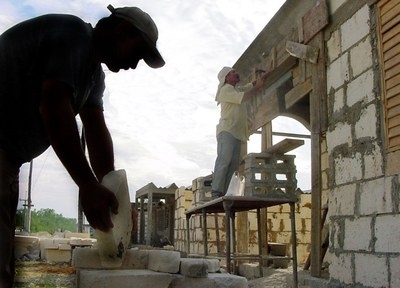
Old inefficiencies in the investment processes, constructions, contractual and credit relations, and imports again have affected the Cuban economy in 2013.
Pressured by cuts in the returns from fundamental external sectors and the domestic burdens the country has been dragging on for 20 years, the Cuban economy closed 2013 with a growth lower than the advance achieved the previous year and, in a more marked way, less than the government’s official plans. According to the report presented by Economy and Planning Minister Adel Yzquierdo in a meeting of the Council of Ministers – reiterated a few days later in Parliament -, the gross domestic product (GDP) this year increased 2.7 percent, almost a percentage point below the plan, which had been 3.6 percent.
For the third year in a row, the economy has not been able to meet the government goal. In 2012 it grew 3 percent and in 2011 it was 2.7 percent, on both occasions four decimal points below the boost initially previewed by the government. But on those occasions it increased every year as compared to the previous. The slowdown actually appeared with the current close of the year and will intensify in 2014, a year for which the Economy and Planning Ministry is forecasting a GDP growth of 2.2 percent.
The increase is increasingly farther away from the level estimated by the island’s economists as necessary to sustain development: around 6 percent per year. It is also distant from the 5.1 percent the economic authorities had projected as a mean annual GDP growth for the 2011-2015 five-year period.
Yzquierdo cited the factors that affected the economy since last January, among them the effects suffered by national revenues in hard currency, as well as the non-fulfilment of the plans by the manufacturing industry, constructions and investments.
Cuban press analysts mentioned important products in the export portfolio that this year suffered a fall in prices, with the subsequent loss for Cuban accounts in hard currency: nickel and sugar. The blow was markedly higher for the metal, which in June dropped to its lowest price in three years on the world market. After having reached a bit over 18,200 dollars per ton in February it dropped to some 13,300 dollars in early July. Currently it is oscillating at 17,000, but the perspectives are grey.
The red light also lit up for another of the principal sources of hard currency for Cuba. The flow of tourists did not surpass the amount registered a year before. The arrival of foreign visitors decreased 1.2 percent up to the close of October, though high-ranking Tourism Ministry officials have expressed their optimism regarding the recently initiated peak winter season. In any case, what is most probable is that the country will arrive at an amount of international tourists similar to the more than 2.8 million registered in 2012, with which it would not fulfil the hopes of achieving 3.1 million, which the sector’s authorities still had in May.
The list of problems acknowledged by the economy ministry still includes old dilemmas of inefficiency, low productivity and the inability to adequately plan and later meet the plans and the business contracts that derive from this.
Yzquierdo also cited among the causes the delay in imports and the execution of the credit capacities.
Like years before, when making a similar balance before the National Assembly of People’s Power, he critically mentioned the immobilisation of resources derived from problems analogous to those of 2013 in the contractual and credit relations, the investment processes and imports.
Despite the cited difficulties, the minister said that the Cuban goods and services trade balance is closing with a positive result of 1.256 billion dollars. Though for years the balance of goods has been dragging a strong commercial deficit, the export of professional services compensates for the total calculations. The physicians working abroad are responsible for the largest contribution, with incomes estimated at around six million dollars.
Judging by the official forecasts, the panorama will not change much next year. The manufacturing industry will be hindered by financial restrictions acknowledged by the government before the deputies. On the other hand, the authorities expect more solid growths in three sectors they have defined as strategic: the sugar agribusiness, agricultural productions and tourism.
Despite the financial obstacles – previewed to be stronger in 2014 -, the retail mercantile circulation has grown in both currencies, with a result favourable to the domestic financial balance and signs of hope in the foreign environment. While still recognising the barriers faced by Cuba to gain access to foreign credits, President Raúl Castro referred with satisfaction in Parliament to one of the objectives adopted by the government under his command: recovering the discipline to “strictly” meet “the assumed financial obligations” with foreign creditors. In that sense he commented on the important advances made in the debt restructuration processes.
Though the president did not mention before the deputies the countries by their name, the Ria Novosti press agency recently reported that Russia and Cuba had reached an agreement to condone 90 percent of the debt contracted by the Caribbean country with the former Soviet Union and whose total value amounts to 32 billion dollars, according to Russian and European diplomats.
Cubans’ greatest expectations, however, point in another direction. On the macroeconomic scale as well as that of consumers, the presentation is still pending of the benefits derived from the transformations undertaken in the Cuban economy, which in 2013 were evidently deep, no matter how much Raúl Castro insists publicly on resisting the pressures to speed up the reforms. (2013)
Su dirección email no será publicada. Los campos marcados * son obligatorios.
Normas para comentar:
- Los comentarios deben estar relacionados con el tema propuesto en el artículo.
- Los comentarios deben basarse en el respeto a los criterios.
- No se admitirán ofensas, frases vulgares ni palabras obscenas.
- Nos reservamos el derecho de no publicar los comentarios que incumplan con las normas de este sitio.
