Sights set on Asia
The presence of the Vietnamese prime minister in Cuba confirmed the intention of expanding bilateral trade.
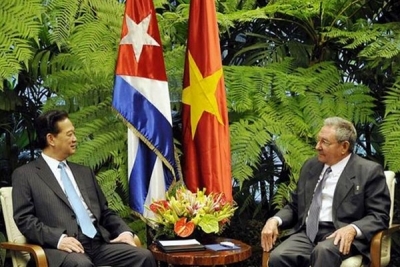
In recent years, the visits and talks between Cuba’s high-ranking leadership and Vietnam have become frequent.
Cuba is looking toward the Far East though without haste. A visit to Havana by Vietnamese Prime Minister Nguyen Tan Dung in late March confirmed the excellent state of political relations between both countries and the official will to expand bilateral economic links. The statements come after several years of a reduction in common trade ties.
In addition to successive meetings with the highest ranking leadership of the Caribbean country, including a meeting with the historic leader of the Cuban Revolution, Fidel Castro, the Vietnamese prime minister was awarded the highest decoration conferred by the island’s State, the José Martí Order, by Cuban President Raúl Castro.
During the visit, both countries signed the Mid-Term Bilateral Economic Agenda, with the intention that it serve as “a guide for economic relations in the next five years,” as well as a memorandum of understanding between the Cuban Public Health Ministry, the BioCubaFarma industrial group and the Indochinese country’s Public Health Ministry to promote cooperation in the health sphere.
In the joint communiqué the parties agreed on “actions to strengthen relations between Vietnam and Cuba, especially in the areas in which each country has potentials and advantages to complement themselves, like trade, agriculture, telecommunications, energy, public health, biotechnology, pharmacology, construction, defence, tourism, education and training.”
However, the traditional ties of friendship have not achieved a similar expression in the economic field, judging by official data and what the Cuban leaders have said.
In successive talks with Tan Dung, First Cuban Vice President Miguel Díaz-Canel as well as Parliament Speaker Esteban Lazo expressed interest in increasing bilateral economic-trade ties at the same level as the political relations, which they recognised were at their best moment.
However much the official statements insist on expressing general satisfaction over the advance of relations, the Cuban concern has been present for some time now. During the last Havana International Trade Fair (FIHAV 2013), Foreign Trade and Investment First Deputy Minister Antonio Carricarte spoke about this in a meeting with Vietnamese businesspeople. “Even though our trade is growing,” he said, “it is far from the level of political relations between both countries.”
Vietnam ranks second among Cuba’s trade partners in Asia, but rather behind China. According to the Cuban Statistical Yearbook, Hanoi ranks in 14th place among the countries trading with the Caribbean country. From 2007 to 2012 bilateral exchange has shown an irregular tendency, with signs of cooling. In the past decade, it grew to a record of more than 500 million dollars in 2008, tenfold the level registered a decade before. But starting that year it decreased to less than 200 million dollars in 2012.
As a partial mitigation, the Chamber of Commerce of Cuba reported that the exchange between both countries increased 50 percent in the first half of 2013 as compared to the same period the previous year.
Though the common visits between Cuban leaders and representatives from Vietnam as well as from China have become frequent, the truth is that trade with Asia, in third place after America and Europe, does not show the greatest expansion. In 2012 it even decreased to levels below those of 2007 and 2008.
Exchange with Latin American countries, like Venezuela and Brazil among the most significant cases, is advancing at a better pace.
Another symptom of imbalance in trade with the South East Asian nation is that 96 percent corresponds to exports from that country to Cuba. Havana, however, has reasons to be thankful for this. Hanoi is the principal supplier of a basic foodstuff in the Cuban diet, rice, in addition to providing advisory services to expand this cereal’s harvest on the island. Cuba receives from Vietnam, at preferential prices, the major part of the 400,000 tons of rice it imports.
Meanwhile, Vietnamese companies have expanded their presence in Cuba in strategic fields like offshore oil exploration, and ranked among the first in responding to Cuba’s invitation to invest in the Mariel Special Development Zone.
The Vietnamese prime minister took advantage of his stay to visit in Pinar del Río, Cuba’s westernmost province, one of the eight agricultural enclaves where technicians from his country offer advisory services to expand rice production. The collaboration project aims to increase by 40,000 hectares the planting area, as well as their yields.
A fourth of the record of close to 400,000 tons of rice for consumption harvested in Cuba in 2013 bore the Vietnamese stamp: 99,100 tons, with a yield of 4.54 tons per hectare, more than the 1.18 registered in 2002, the year in which collaboration in that area started. For 2016 Cuba aims to increase production to more than 530,000 tons to thus cover two thirds of domestic demand.
The Vietnamese contribution will then have a significant impact on Cuba’s foreign accounts by reducing today’s high expenditures in food imports. (2014)
Su dirección email no será publicada. Los campos marcados * son obligatorios.
Normas para comentar:
- Los comentarios deben estar relacionados con el tema propuesto en el artículo.
- Los comentarios deben basarse en el respeto a los criterios.
- No se admitirán ofensas, frases vulgares ni palabras obscenas.
- Nos reservamos el derecho de no publicar los comentarios que incumplan con las normas de este sitio.