The prevalence of a patriarchal ideology in Cuban society and, therefore, in health and justice professionals, has an incidence in their low perception of sexist violence and the little visibility of that problem on a social level. In addition, the lack of specialised institutional mechanisms to attend to that problem strengthens the idea that it is a private matter, when actually it demands a social response.
For many Cuban professionals, even of Social Sciences, it is very difficult to recognise that Cuban society is patriarchal. Faced by the fact that in Cuba women and men are equal before the law, that they earn the same wages for the same work, that Cuban women have a high educational level and that they have an almost 50 per cent representation in Parliament (48.86%), it becomes difficult to identify that, socially, the masculine continues having a hierarchical position over the feminine.
Participation is fundamental to the process of constructing citizenship, and specifically sexual citizenship, on the road to achieving the true equality and emancipation of human beings.
The victorious Cuban Revolution brought a radical change to gender relations, via the joint participation of men and women in building a project for a more equitable nation. In addition, policies were formulated that have supported the empowerment and gradual exercise of the rights of heterosexual women, as well as the gradual erosion of the hegemony of masculinities.
Educational institutions can be spaces promoting gender equality as well as centres for the reproduction of discrimination, whose naturalisation is one of the elements favouring the longevity of patriarchy.
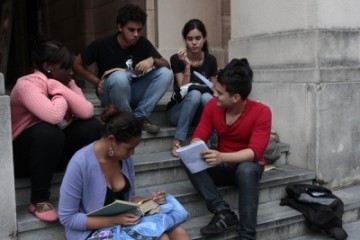
In Cuba, the institutional laws and policies favour the access of women and men to university, as well as professional work; but historic-cultural mandates prevail that determine different ways of socialising for one and the other based on what is conceived as feminine and masculine. The social and subjective changes are not on a par with the implemented laws and policies. After working for five days with a group of young university students it was possible to reveal a gender image that, while inheriting traditional ways of conceiving gender relations, attempt to incorporate innovative ideas and seeks referents – non-existing – that distance themselves from what is understood as inequalities, which is why they are constantly submitted to contradiction and to a way of conceiving reality in tension, typical of contemporary times.
A system of provincial media functions in Cuba that does not assume the communication or institutional models of the local press.
Local development is not frequently dealt with by social sciences in Cuba, especially in those of communication, a lack observed in the daily practice of the Caribbean nation’s press. However, it is an element taken into account in the economic, political and social reforms being implemented to get around the more than 20-year-old economic crisis.