
Inopportune and welcome
The rains that have come with the Cuban winter have affected strategic activities like the sugar harvest and tobacco planting.
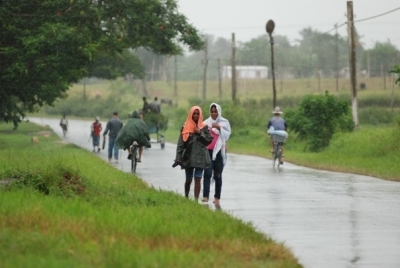
The precipitations have been reanimated since December, in full dry season, after a 2013 with important signs of drought, but the whims of climate have led to setbacks for some productions.
After a more than usual warm Christmas and New Year’s Eve, even for the Caribbean tropics, winter finally appeared in Cuba in January. But the cold fronts have arrived accompanied by rain – unusual for this time of the year –, bringing relief and at the same time unease for the agricultural scenarios. While the cattle farmers and tuber and grain producers appreciate the showers, other key sectors for the economy, like the sugar agribusiness and tobacco production, curse the inopportune humidity.
The dry season in the Cuban archipelago, which lasts from November to April, this time got here after a 2013 with irregular and a shortage of precipitations that got to be worrisome in some regions. In general, the reservoirs ended up being filled. Specialists from the National Institute of Hydraulic Resources reported that up to September the rains made it possible to collect 6.443 billion cubic metres in the reservoirs, 70.6 percent of the total filling capacity.
But not all the territories were able to store the liquid in the same way: provinces like Artemisa, Pinar del Río, Ciego de Avila and Havana’s water sources were benefitted by the precipitations in the last three months of the year, while Matanzas, Camagüey, Las Tunas, Santiago de Cuba and Guantánamo finished the year in a tighter situation.
According to a recent climate watch bulletin of the Climate Centre of the Institute of Meteorology, 28 percent of Cuba’s geographical area registered a deficit in collected rain in 2013. This institution classified the lack of rain in seven percent of the territory as extreme to severe, the same amount as moderate and 13 percent weaker.
Despite the fact that February, June and August are part of the rainy season, these months closed with the highest percentages of areas damaged by the drought, according to the report by the Climate Centre specialists.
The current dry season, on the other hand, has presented precipitations welcomed by agricultural and livestock productions, especially in Cuba’s eastern region. In Camagüey, the province with the biggest herd of cattle, seven percent of the more than 9,000 wells for supplying water to the cattle are dry. Faced by such a situation, the livestock producers have resorted to cistern trucks to supply water to more than 72,000 heads of cattle.
Contradictorily, the same rains blessed by the cattle farmers since December brought to a standstill the sugar harvest in that province. The four sugar mills located in Camagüey were able to resume their grinding this week, after a forced recess in January due to the heavy winter rains.
The Antonio Guiteras sugar mill, in the neighbouring province of Las Tunas, suffered the same fate. Barely a few hours after joining the current harvest on January 17, Cuba’s largest sugar producer was forced to stop the machines because of the excess humidity of the raw material. The province’s two other sugar mills, the Amancio Rodríguez and the Majibacoa, have also reported lost time in this harvest because of a similar reason.
On the other tip of the island the rains also disturbed the planting campaign of a strategic sector for Cuban exports, tobacco. Pinar del Río, which contributes 70 percent of the national tobacco production, has suffered devastations due to excess water since December. According to data from the provincial tobacco group, 813 planted hectares were lost between November and mid January and another 1,085 suffered partial damages.
Out of a plan of 15,389 hectares, Pinar del Río’s tobacco growers had to pull out the crops in hundreds of tobacco plantations damaged by the out-of-season precipitations, to again plant them. In an effort to reduce the losses they have prolonged by a month and a half the planting schedule, which should have concluded in early January.
These events, however, are still not showing signs of the relaxed dry season. Judging by the reports of the Climate Centre, the year 2013 joined the drought that has been affecting Cuba since November 2008, and which was particularly severe in 2009, a year classified as the fourth registering the least rains in 109 years.
Though still not reaching the severe levels of 2003 and 2004 – the most serious drought of the last 100 years reduced by up to almost 27 percent the water collected in reservoirs and made it necessary to distribute water to more than a million and a half persons using cistern trucks -, the current deficit of precipitations has forced the government to finance the constructions of aqueducts, canals and transfers to better use the available water. These are vital investments to avoid the failure of an economic programme approved by the government as a national security strategy five years ago: food production. (2014)
Su dirección email no será publicada. Los campos marcados * son obligatorios.
Normas para comentar:
- Los comentarios deben estar relacionados con el tema propuesto en el artículo.
- Los comentarios deben basarse en el respeto a los criterios.
- No se admitirán ofensas, frases vulgares ni palabras obscenas.
- Nos reservamos el derecho de no publicar los comentarios que incumplan con las normas de este sitio.
