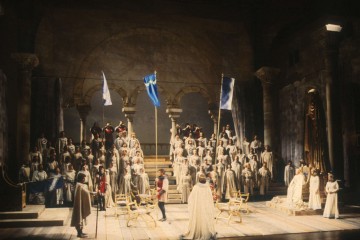
Tannhäuser was premiered on October 19, 1845 in the Dresde Royal Theatre.
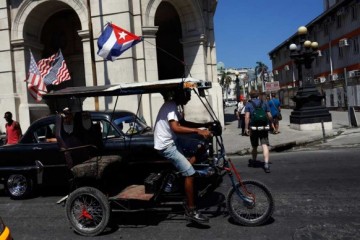
The recent celebration of Holy Week in Havana has been marked by singular features that border on what AlejoCarpentier called “magic realism” since it included the visit by U.S. President Barack Obama, the one-time concert of The Rolling Stones and to top it off, the premier on March 26 and 27 of the operatic drama Tannhäuser in a production by the National Opera Theatre of Cuba, with the support of the Richard Wagner Society of Germany and the Goethe Institute. The stage production in the Alicia Alonso Grand Theatre was directed by Andreas Baesler, while the music was conducted by well-known Walter Gugerbauer.
Summary of Cuban policy in 2015 on the threshold of a key event in 2016, the 7th Congress of the Communist Party of Cuba.
In 2015 Cuba was at the centre of the news. Cuban diplomacy advanced in its talks with the United States to restore bilateral ties after more than half a century of conflict, while it negotiated with the European Union a political and cooperation dialogue agreement. President Raúl Castro was warmly embraced by Latin America at the Panama Summit of the Americas, the first the Caribbean island was able to attend, was the host to Pope Francis and travelled to New York where he took advantage of his four-day stay to meet for the second time with his U.S. colleague Barack Obama.
The Cuban government put into force new regulations for the payment systems to bring enterprises closer to the paradigms of efficiency and productivity proposed by the process of economic changes.
One of the most sensitive subjects in the sphere of labour and daily life in Cuba, wages, again came to the fore this month. The Labour and Social Security Ministry (MTSS) put into force on April 1 Resolution 6 to modify the payment systems according to results applied in the Cuban entrepreneurial system.
A new way of writing is emerging in Cuba which doesn’t have the island as the centre of its concerns.
Every time I have been a jury member in some of the many literary contests summoned in Cuba, I have become convinced that a young literature is opening a path in the country, a literature whose formal excellences and concerns alien to the sociologism of the 1990s allows for appreciating a rupture with previous generations.