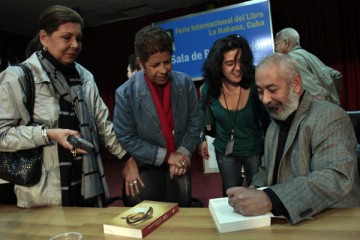
Tired, but happy. That’s how Leonardo Padura described himself on his return from Mexico in early December. There, at the Guadalajara Book Fair, he presented a commemorative edition prepared by Mexico’s Tusquets Publishers of Pasado perfecto (Havana Blue), that novel published precisely by a small publishing house in that city in 1991, a book in which the then young writer was making his debut in the detective genre with an also young character, Mario Conde. At that time Padura could not suspect that 25 years later he would be celebrating at the most important Spanish language book fair, with a special re-edition included, the birth of that atypical and melancholic, though deeply Cuban, detective who has been the most constant and loved companion in his already long and fruitful literary trip.
The Cuban government is setting out to strongly increase investments that generate development, despite planning a GDP growth of barely 2 per cent.
After confirming a moderate 4 per cent growth of the economy in 2015, for the new year the Cuban government is aiming at a more restrained increase of the gross domestic product (GDP) of 2 per cent, which it defined as a very tense goal.
Thesending, distribution and use of remittances is not only determined by the economic context and the market, but also by the situation of material poverty of the families receiving them and the power relations established inside their homes, especially the gender relations, which involve different behaviours and in the way women and men act.
On the other side of the sea those beloved beings
Will sit at the table trying not to look at
The place which used to be yours
One less mouth to feed
Does not make up for the void your absence left
Nadine Sarreal, Philippine poetess
The gender perspective modifies and notably enrichesthe debate on remittances and poverty and allows for going beyond a discourse that reduces them to the discussion of their potential to revitalise consumption or productive investment within a mercantile monetary logic. The majority of the economic research does not take into account the amount of money sent by migrant persons, how that money is sent and used are determined not only by the market economy, but also by the political economy of the home and the relations of power.
They were five boys and one girl – all of them between 8 and 10 years old – in the cafeteria, and one of the boys was being encouraged by the others to court the girl, who was not showing any signs of being annoyed or inconvenienced; I would say that for her the situation was “normal.” The adults present in the place were not paying attention to these events, only I was asking myself what had happened to the innocence of these children.