Padura to film

The Spanish-Cuban production “Vientos de La Habana” is being premiered on September 30 in Spain’s commercial movie theatres.
The Spanish-Cuban production “Vientos de La Habana” is being premiered on September 30 in Spain’s commercial movie theatres.
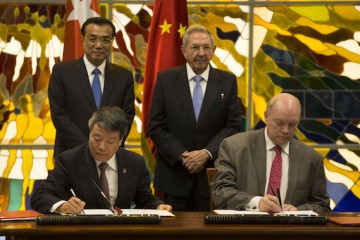
The Cuban government is expanding its commercial and financial relations with two leaders of the Asian and world economy: Japan and China.
Cuba is intensely manoeuvring to shorten the distances with leading Asian economies, in line with the strategy of diversifying commercial ties with the world. Meanwhile, from the Far East they are viewing with interest the largest of the Caribbean islands at a time when the government of Raúl Castro is dialoguing with the United States. Chinese Prime Minister Li Keqiang landed at Havana’s José Martí International Airport on September 24. The day before his Japanese counterpart, Shinzo Abe, departed from the same city.

This article by the famous Cuban writer was published originally in Portuguese in the newspaper Folha de Sao Paulo and has been reproduced in Spanish and English thanks to an agreement with IPS Cuba.
One of modern society’s values is – or should be – respect for the individual’s private sphere. Persons’ interests, their form of understanding diverse aspects of reality and existence, their individual tastes and phobias are estimated as arcane belongings that the social context should protect, as long as those personal preferences are not detrimental to the rest of the fellow citizens.

The current labour conditions referred to in the new Labour Code will only be real opportunities for persons if they are coordinated with other policies that must accompany the implementation of this labour regulation. The active and promoting policies of innovation must be directed at both the state-run and non-state sectors, as dynamic and innovative economic spheres. They must also focus on the optimum use of the Cuban population’s qualification, in three basic directions: increase the remuneration in a segment of excellence linked to strategic objectives, expand the wage differentiation with greater emphasis on work complexity and results; make more flexible the labour mechanisms in the state-run sector and other forms of ownership.
The Cuban economy received the international crisis with a weak macroeconomic situation as a result of the accumulation of a group of domestic and foreign imbalances. It is expected that this 2016 will continue the structural tendency toward a slowdown of the Gross Domestic Product (GDP).