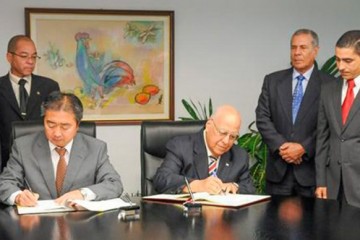
The Asian power accepted writing off around two thirds of Havana’s millions of dollars’ worth of debt in an agreement that is a follow-up to what was agreed upon almost a year ago with the Paris Club.
Cuba took with Japan another important step in its strategy to organise foreign accounts and recover international financial credibility. Both countries signed this week an agreement to regularise the Cuban debt with this Asian power, which is close to 180 billion yens or 1.75 billion dollars.
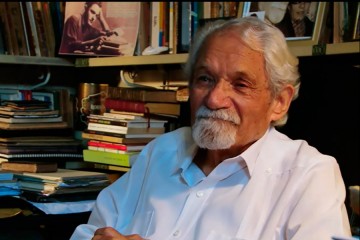
Because of his considerable contribution to the development of academic exchange between the United States and Cuba, the poet recently received the Latin American Studies Association (LASA) award.
With his more than eight decades of existence, Cuban poet, narrator, academician and diplomat Pablo Armando Fernández (Delicias sugar mill town, 1930), one of the most notable representatives of the so-called Generation of the 1950s, received in the privacy of his home the LASA Award.
Though the government’s will and many of the policies established are directed at trying to position a gender-related focus in the different spheres of Cuban society, a great deal of the population and among many key social actors there are still sexist representations regarding gender, which reproduce discriminatory, biased and not very healthy practices for women and men. In this context, it is pertinent to work on the subject matter of gender during childhood, with an educational intention. This allows for having an early influence in the process of forming the personality and promoting beliefs and values coherent with gender equity.
Gender equity and women’s empowerment are one of the Millennium Goals Declaration, a document of the United Nations that served as a world common action and cooperation framework on development, since it was approved in 2000 and up until 2015, when the period of time to meet these goals ended. However, in 2013 gender equity was still considered one of the areas in which the advances had to be boosted and more audacious measures had to be taken.
The Cuban government has extended to state-run enterprises the application of taxes that already regulated other economic activities and sectors.
The news spread like wildfire through the streets, the press and the Internet. It unleashed concerns among Cubans, motivated extensive radio and television programmes, public forums with government officials and also served as gossip for the opposition when it actually is something common in any world economy. But the decision of applying in Cuba a special tax for social security and on personal income to workers in state-run enterprises is not a novelty.